Medical uniforms are not what they once were. Have you noticed how they have become actually fashionable. Of course that could be because the selection of companies out there providing them has expanded so. They are everywhere. But for a busy medical professional who most likely does not have the time to spend a day driving around looking and looking for scrubs in fashion there are now online ordering possibilities. What better way to pick out fashionbable medical scrubs then in the comfort of your own home or desk, and ordering in a non-harried way. And even though there are fashionable medical scrub choices out there, they are not always easy to find.
And if comfort is also on your mind when looking for your medical scrubs then look no further than
dickies medical uniform. Comfort, quality, style all can be part of medical wear. A long day at work, on your feet most of the time, you must consider comfort as well as style. Quality of the material also insures comfort. But when you can also get something stylish as well as comfortable. No more white and hospital greens, you now have bright and beautiful choices of colors and styles. And you nca enjoy your day off at home, not driving around trying to find the perfect medical scrub. Just think of the possibilities!
Wednesday, December 8, 2010


Wednesday, November 17, 2010
Eggnog: That Little Taste of Christmas
By: Karly Berezowsky

Eggnog is a worldwide holiday beverage, but its' ingredients vary from place to place. Some historians believe that the eggnog that we know today came from a British drink known as posset, which was made out of wine, milk and eggs. Posset was served hot and sometimes people even added figs to it for the sweetened taste it added. It is was not until much later until eggnog became a drink that was traditionally served cold.
Europeans also had a concoction that consisted of ale and milk that was similar; while in United States Eggnog is made using rum and milk. The drink became popular amongst the rebellious colonists in the cold winter times because it kept people warm due to the alcohol and it was tasty due to its'spices. The spices were imported through trade in addition to the rum that was most likely a result of trading in the Caribbean.
During the earlier years Eggnog was made with milk, eggs, and some kind of alcohol, which was usually brandy or sherry. Brandy was an ingredient that was added later on in the 1800's. It became a drink that was associated with socializing at parties around the holiday season.
Some farmers used to drink eggnog at their leisure because it was common for them to have a few cows and chicken, in addition to some liquor stored in the house; it was a relatively quick drink to make.
All in all, eggnog is a wintery pleasure to all of those that are of drinking age. However, not to worry there are also non-alcoholic versions in the Holiday book "The Basic Art of Italian Cooking: Holidays & Special Occasions-2nd edition" that can be enjoyed by everyone at any time of the year.
For more Holiday tips, recipes and decorating tips get your copy of the book selected as the Best Italian Cuisine Book in the USA- The Basic Art of Italian Cooking: Holidays Special Occasions-2nd edition
Eggnog is a worldwide holiday beverage, but its' ingredients vary from place to place. Some historians believe that the eggnog that we know today came from a British drink known as posset, which was made out of wine, milk and eggs. Posset was served hot and sometimes people even added figs to it for the sweetened taste it added. It is was not until much later until eggnog became a drink that was traditionally served cold.
Europeans also had a concoction that consisted of ale and milk that was similar; while in United States Eggnog is made using rum and milk. The drink became popular amongst the rebellious colonists in the cold winter times because it kept people warm due to the alcohol and it was tasty due to its'spices. The spices were imported through trade in addition to the rum that was most likely a result of trading in the Caribbean.
During the earlier years Eggnog was made with milk, eggs, and some kind of alcohol, which was usually brandy or sherry. Brandy was an ingredient that was added later on in the 1800's. It became a drink that was associated with socializing at parties around the holiday season.
Some farmers used to drink eggnog at their leisure because it was common for them to have a few cows and chicken, in addition to some liquor stored in the house; it was a relatively quick drink to make.
All in all, eggnog is a wintery pleasure to all of those that are of drinking age. However, not to worry there are also non-alcoholic versions in the Holiday book "The Basic Art of Italian Cooking: Holidays & Special Occasions-2nd edition" that can be enjoyed by everyone at any time of the year.
For more Holiday tips, recipes and decorating tips get your copy of the book selected as the Best Italian Cuisine Book in the USA- The Basic Art of Italian Cooking: Holidays Special Occasions-2nd edition
Friday, October 1, 2010
Be Prepared
Yesterday I met a woman that survived the Katrina Floods of New Orleans, she told me a heart wrenching tale of surviving during and after the storm. It made me think about Emergency Preparedness. As the saying goes ‘one can never be too prepared’ and in this age of many a natural disaster a saying can never ring truer.
Today it is easy to prepare for emergencies with the many choices of Emergency Kits that have been developed for these very types of emergencies. And it’s no wonder, having an emergency kit on hand makes one less thing to worry about. When disaster strikes there are too many other things to think about and if you are prepared with a food supply on hand, bandages, water supply, you will have the confidence to pull you through. There are many options out there with long lasting,dehydrated food supplies, kits in backpacks available just for these situations. So the work has already been done for you. All you need to do is find a place to store your emergency supplies
And who knows, maybe you will be fortunate enough to never experience a natural disaster, like the woman that survived Katrina did, but if you do you will have the peace of mind knowing that you will be prepared for an emergency with everything you and your family may need to make it through.
Emergency Preparedness is one of the keys to surviving one of the many natural disasters of today and it couldn’t be any easier today than to do as the Boy Scouts profess-‘Be Prepared’
Today it is easy to prepare for emergencies with the many choices of Emergency Kits that have been developed for these very types of emergencies. And it’s no wonder, having an emergency kit on hand makes one less thing to worry about. When disaster strikes there are too many other things to think about and if you are prepared with a food supply on hand, bandages, water supply, you will have the confidence to pull you through. There are many options out there with long lasting,dehydrated food supplies, kits in backpacks available just for these situations. So the work has already been done for you. All you need to do is find a place to store your emergency supplies
And who knows, maybe you will be fortunate enough to never experience a natural disaster, like the woman that survived Katrina did, but if you do you will have the peace of mind knowing that you will be prepared for an emergency with everything you and your family may need to make it through.
Emergency Preparedness is one of the keys to surviving one of the many natural disasters of today and it couldn’t be any easier today than to do as the Boy Scouts profess-‘Be Prepared’
Wednesday, September 22, 2010
The Beginnings of Pizza

Guest Writer: Karly Berezowsky
The origins of pizza, the infamous crowd favorite, date all the way back to the Ancient Egyptians, the Babylonians, and other areas in the Middle East, way before the Greeks and Romans had it. Archeological historians believe that many Middle Eastern people of ancient times had a type of flat, un-raised dough that they put various sauces on. However neither the Egyptians, nor the Indians had toppings on their “pizza” but the Persians may have. Both the Greeks and Romans had a culinary creation that consisted of a type of flat bread adorned with some oil and spices . This goes totally against the common notion that the Italians were the ones to invent pizza.
This legend is derived from a story from around 1889 which stated that King Umberto I and Queen Margherita ate the food of the commoners which was a form of pizza and loved it. A man by the name of Raphaelle Esposito was charged with making a pizza for her, the Queen of Italy; he created a pizza topped with tomatoes, mozzarella cheese, and basil; and to this day it is still called the Margherita pizza .
Over the years the pizza phenomenon went global, it became a fan favorite all around the world. It is just as huge in America as it was in Italy. In 1905 a man named, Gennaro Lombardi was the first to ever obtain a license to sell pizza in the United States. He opened up shop in New York City . Eventually people caught on to the idea that this was a profitable business so people began opening up pizzerias all over New York and then up in Connecticut and further north. It then spread down the coast. Traditionally New York style pizza has a very thin and crunchy crust. Pizza became extremely popular in the United States after World War II because many soldiers ate it when they were overseas and enjoyed it. The establishment of pizzerias across the United States began between the late 1940s-1950s.The deep dish Chicago pizza was supposedly created by Ike Sewell in 1943 . It took a while for the pizza makers to move out west; it was not until 1973 when Alice Waters started making veggie pizzas out in California.
Do you love Pizza??, get the award winning book The Basic Art of Italian Cooking: Holidays & Special Occasions-2nd edition. Selected as the best Italian cuisine Book in the USA
Visit The Basic Art of Italian Cooking by Maria Liberati tm
Saturday, September 18, 2010
Espresso- a Fast Food
Guest Blogger: Karly Berezowsky
 The word 'espresso' translated from Italian into English literally means fast. The first espresso machine was invented in France in 1822 . A man named Luigi Bezzera experimented with ways to speed up the brewing process of coffee. In 1903 is when he discovered that by increasing the pressure, directly causes the brewing time to be significantly shorter. He invented the Fast Coffee Machine. However, despite his best efforts he did not have the money or financial backing that was needed to market his machine.
In 1905 Luigi Bezzera sold the rights and patent to the machine to a man named Desidero Pavoni. It was Pavoni that successfully launched espresso and the espresso machine to the Italian people. In Italy alone there are currently well over 220,000 coffee bars.
Today, espresso machines transfer the water at an increased pressure level through the espresso grinds, thereby forcing it through the metal filter and into a person’s cup. Some believe that espresso should be consumed very quickly after being made because shortly afterwards it begins to break down, thus explaining why it is served in small quantities in short cups.
Espresso quickly spread throughout the globe. It was then incorporated as the main ingredient of numerous coffee drinks such as the macchiato, cappuccino, mocha, various lattes, as well as other blended drinks.
Espresso has a unique taste that is both bittersweet and rich. If one dislikes the strong taste of the shot it can be combined with any type of creamer to create a lighter taste.
One of the problems facing coffee marketers today is that many people are choosing to buy coffee that is of less quality because it is less expensive instead of opting to buy the high quality brands due to the poor economic situation, therefore the sales of expensive coffee beans has been slightly declining over the last few decades.
In addition to this, much of the younger population, especially in the United States are so entrenched in drinking overtly milk/crème based blended medleys from coffee chains that produce a lesser quality brew, presumably because of the sweeter taste, that they have developed a misconception of what real coffee or espresso is supposed to taste like.
So if you want to know what a real espresso should taste like venture to one of Italy's famous coffee bars-even if only once- to find out what a real espresso was meant to be.
For great info and recipes get your copy of the award winning book The Basic Art of Italian Cooking : Holidays & Special Occasions

In 1905 Luigi Bezzera sold the rights and patent to the machine to a man named Desidero Pavoni. It was Pavoni that successfully launched espresso and the espresso machine to the Italian people. In Italy alone there are currently well over 220,000 coffee bars.
Today, espresso machines transfer the water at an increased pressure level through the espresso grinds, thereby forcing it through the metal filter and into a person’s cup. Some believe that espresso should be consumed very quickly after being made because shortly afterwards it begins to break down, thus explaining why it is served in small quantities in short cups.
Espresso quickly spread throughout the globe. It was then incorporated as the main ingredient of numerous coffee drinks such as the macchiato, cappuccino, mocha, various lattes, as well as other blended drinks.
Espresso has a unique taste that is both bittersweet and rich. If one dislikes the strong taste of the shot it can be combined with any type of creamer to create a lighter taste.
One of the problems facing coffee marketers today is that many people are choosing to buy coffee that is of less quality because it is less expensive instead of opting to buy the high quality brands due to the poor economic situation, therefore the sales of expensive coffee beans has been slightly declining over the last few decades.
In addition to this, much of the younger population, especially in the United States are so entrenched in drinking overtly milk/crème based blended medleys from coffee chains that produce a lesser quality brew, presumably because of the sweeter taste, that they have developed a misconception of what real coffee or espresso is supposed to taste like.
So if you want to know what a real espresso should taste like venture to one of Italy's famous coffee bars-even if only once- to find out what a real espresso was meant to be.
For great info and recipes get your copy of the award winning book The Basic Art of Italian Cooking : Holidays & Special Occasions
Wednesday, August 25, 2010
The Year of Caravaggio
copyright 2010 art of living, PrimaMedia,Inc.
Guest Post by : Karly Berezowsky
This is the year of Caravaggio, the famed Italian artist.. Here are some interesting facts about one of the many geniuses of Italian art..Recently, a Caravaggio painting has been recovered in Berlin, Germany, after being pilfered in 2008 in Odessa, Ukraine. The stolen piece was actually a modern replica of Caravaggio’s Taking of Christ. It has been proclaimed by art historians that the Taking of Christ was not painted by Caravaggio due to distinct differences in the painted figures. It may have been painted by one of his students; despite being manifested as an original Caravaggio by the Soviets in 1950.
But to understand how it was contrived a fake one must understand how immensely avant-garde Caravaggio truly was during the Italian Baroque period. Caravaggio was wholeheartedly innovative and anarchistic because he is taking off the blindfold and showing real issues like murder and squalor. This painting portrays an extremely traumatic murder.
Caravaggio was an Italian Baroque painter. He lived a rough life, he was arrested multiple times. He used ordinary common folk such as people in the streets as his models. He painted down-to-earth, real earthly people with real problems. The subject matter for the majority of his works was religious scenes. He committed a murder and there was a price on his head to bring him in alive or dead. His temper caused him to get into many fights and upset a lot of townspeople which forced him to flee to various areas of Europe. But a life on the run could only last so long.
Caravaggio was an innovator that used techniques called tenebrism and chiaroscuro throughout his work. Many of his pieces are considered to be Shock Theater because they are so dramatic and have theatrical elements to them. For instance, some of his paintings have spotlight lighting and drawn red curtains.
Caravaggio painted what he saw, using people on the streets as models. The Calling of St. Matthew depicted Jesus Christ pointing at Matthew in a dim dive of a tavern. The action starts to the left and then flies off to the right; this makes the composition dynamic because it forces your eyes to move with the unfolding scene.
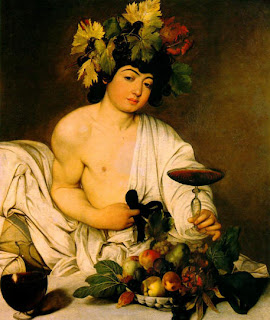
Caravaggio had an interesting take on classical art which can be seen in his painting, Boy with a Basket of Fruit. In which he makes the God Baccus look sickly due to his greenish skin color, when he is supposed to be the god of wine and merriment. Caravaggio made the God Baccus look more earthly and unkempt. Caravaggio is in a way rejecting the classical form of art by making it more seedy and run-down.

Caravaggio was rejected after he painted The Death of the Virgin. One of Caravaggio’s most famous pieces was Death of the Virgin. It was commissioned for the Church of Santa Maria. His patrons hated it so much they actually returned it to him, totally rejecting his art and skill. It depicts the death of the Virgin Mary. Mary actually looks dead, her flesh is green and the body appears bloated; much like the dead deer do on the side of the road in the summer heat, limbs outstretched and fat. Caravaggio was totally radical painting the Virgin Mary like inflated road kill. It is rumored that he used a drowned whore from the morgue as the model for the Virgin Mary. Just imagine the riot that would ensue if someone painted her like a prostitute today and then plastered it onto the wall of the Vatican. And it is because of all of these clandestine features of the painting that the patron nuns returned it to him. They reasonably objected to the painting because they thought it was too unorthodox because she looks like a corpse which is an indecent image when she is supposed to be an icon of light, heaven and hope.
For recipes and charmingstories on life in Italy get your copy of the award winning book The Basic Art of Italian Cooking: Holidays & Special Occasions-2nd edition

Guest Post by : Karly Berezowsky
This is the year of Caravaggio, the famed Italian artist.. Here are some interesting facts about one of the many geniuses of Italian art..Recently, a Caravaggio painting has been recovered in Berlin, Germany, after being pilfered in 2008 in Odessa, Ukraine. The stolen piece was actually a modern replica of Caravaggio’s Taking of Christ. It has been proclaimed by art historians that the Taking of Christ was not painted by Caravaggio due to distinct differences in the painted figures. It may have been painted by one of his students; despite being manifested as an original Caravaggio by the Soviets in 1950.
But to understand how it was contrived a fake one must understand how immensely avant-garde Caravaggio truly was during the Italian Baroque period. Caravaggio was wholeheartedly innovative and anarchistic because he is taking off the blindfold and showing real issues like murder and squalor. This painting portrays an extremely traumatic murder.
Caravaggio was an Italian Baroque painter. He lived a rough life, he was arrested multiple times. He used ordinary common folk such as people in the streets as his models. He painted down-to-earth, real earthly people with real problems. The subject matter for the majority of his works was religious scenes. He committed a murder and there was a price on his head to bring him in alive or dead. His temper caused him to get into many fights and upset a lot of townspeople which forced him to flee to various areas of Europe. But a life on the run could only last so long.
Caravaggio was an innovator that used techniques called tenebrism and chiaroscuro throughout his work. Many of his pieces are considered to be Shock Theater because they are so dramatic and have theatrical elements to them. For instance, some of his paintings have spotlight lighting and drawn red curtains.
Caravaggio painted what he saw, using people on the streets as models. The Calling of St. Matthew depicted Jesus Christ pointing at Matthew in a dim dive of a tavern. The action starts to the left and then flies off to the right; this makes the composition dynamic because it forces your eyes to move with the unfolding scene.
Caravaggio had an interesting take on classical art which can be seen in his painting, Boy with a Basket of Fruit. In which he makes the God Baccus look sickly due to his greenish skin color, when he is supposed to be the god of wine and merriment. Caravaggio made the God Baccus look more earthly and unkempt. Caravaggio is in a way rejecting the classical form of art by making it more seedy and run-down.

Caravaggio was rejected after he painted The Death of the Virgin. One of Caravaggio’s most famous pieces was Death of the Virgin. It was commissioned for the Church of Santa Maria. His patrons hated it so much they actually returned it to him, totally rejecting his art and skill. It depicts the death of the Virgin Mary. Mary actually looks dead, her flesh is green and the body appears bloated; much like the dead deer do on the side of the road in the summer heat, limbs outstretched and fat. Caravaggio was totally radical painting the Virgin Mary like inflated road kill. It is rumored that he used a drowned whore from the morgue as the model for the Virgin Mary. Just imagine the riot that would ensue if someone painted her like a prostitute today and then plastered it onto the wall of the Vatican. And it is because of all of these clandestine features of the painting that the patron nuns returned it to him. They reasonably objected to the painting because they thought it was too unorthodox because she looks like a corpse which is an indecent image when she is supposed to be an icon of light, heaven and hope.
For recipes and charmingstories on life in Italy get your copy of the award winning book The Basic Art of Italian Cooking: Holidays & Special Occasions-2nd edition
Tuesday, August 24, 2010
Baba Ganoush-a Healthy Dip
copyright 2010 art of living,PrimaMedia,Inc
Guest Post By: Karly Berezowsky
Baba Ganoush is an old world dish made predominately out of eggplant is a refreshing and simple dish to make with origins in the Middle East. It is still eaten today by the Turkish, Armenian, Greek, Romanian people, along with many of Mediterranean origin. Eggplant or aubergine is a popular ingredient in many Italian dishes as well, so this might be something worth trying out. This dish is especially superb for a vegetarian or for someone who is just trying to eat a little healthier.
One may describe it as an eggplant dip. Some people pair it with pita bread; but it is good enough to eat right off of the plate.
The list of ingredients is as follows:
1 pound of eggplant
1 clove garlic, minced
1/4 teaspoon salt
1 handful fresh parsley, minced
2 tablespoons tahini
2 tablespoons lemon juice
Preheat oven to 450 degrees F.
Prick eggplant with a fork and place on a cookie sheet lined with foil. Bake the eggplant until it is soft inside, for approximately 20 minutes. Let the eggplant cool. Cut the eggplant in half lengthwise, drain off the liquid. Scoop out the pulp and place into a food processor. Process the eggplant until smooth and transfer to a medium bowl. On a cutting board, mince garlic and 1/4 teaspoon salt together with the flat side of a knife, until it forms a paste. Add the garlic-salt mixture to the eggplant. Stir in the parsley, tahini, and lemon juice. Season with more salt, to taste. Garnish with additional parsley.
For more great recipes get your copy of the Award Winning Book The Basic Art of Italian Cooking: Holidays & Special Occasions-2nd edition winner of the Best Italian Cuisine Book in the USA by Gourmand World Cookbook Awards
Celebrity Chef Maria Liberati & The Basic Art of Italian Cooking are touring the USA and Canada, upcoming appearances schedule:
Sept 11 & 12-Hudson Valley Wine Fest-Rhinebeck, NY, Dutchess County Fairgrounds. Maria will take center stage at 2 PM on both days and share recipes, stories from her new award winning book The Basic Art of Italian Cooking: Holidays & Special Occasions-2nd edition recipes. Maria will be signing copies of the latest book throughout the weekend event.
For more info email: events@marialiberati.com
Guest Post By: Karly Berezowsky
Baba Ganoush is an old world dish made predominately out of eggplant is a refreshing and simple dish to make with origins in the Middle East. It is still eaten today by the Turkish, Armenian, Greek, Romanian people, along with many of Mediterranean origin. Eggplant or aubergine is a popular ingredient in many Italian dishes as well, so this might be something worth trying out. This dish is especially superb for a vegetarian or for someone who is just trying to eat a little healthier.
One may describe it as an eggplant dip. Some people pair it with pita bread; but it is good enough to eat right off of the plate.
The list of ingredients is as follows:
1 pound of eggplant
1 clove garlic, minced
1/4 teaspoon salt
1 handful fresh parsley, minced
2 tablespoons tahini
2 tablespoons lemon juice
Preheat oven to 450 degrees F.
Prick eggplant with a fork and place on a cookie sheet lined with foil. Bake the eggplant until it is soft inside, for approximately 20 minutes. Let the eggplant cool. Cut the eggplant in half lengthwise, drain off the liquid. Scoop out the pulp and place into a food processor. Process the eggplant until smooth and transfer to a medium bowl. On a cutting board, mince garlic and 1/4 teaspoon salt together with the flat side of a knife, until it forms a paste. Add the garlic-salt mixture to the eggplant. Stir in the parsley, tahini, and lemon juice. Season with more salt, to taste. Garnish with additional parsley.
For more great recipes get your copy of the Award Winning Book The Basic Art of Italian Cooking: Holidays & Special Occasions-2nd edition winner of the Best Italian Cuisine Book in the USA by Gourmand World Cookbook Awards
Celebrity Chef Maria Liberati & The Basic Art of Italian Cooking are touring the USA and Canada, upcoming appearances schedule:
Sept 11 & 12-Hudson Valley Wine Fest-Rhinebeck, NY, Dutchess County Fairgrounds. Maria will take center stage at 2 PM on both days and share recipes, stories from her new award winning book The Basic Art of Italian Cooking: Holidays & Special Occasions-2nd edition recipes. Maria will be signing copies of the latest book throughout the weekend event.
For more info email: events@marialiberati.com
Saturday, July 24, 2010
Eating Seasonally with an Herb Garden

copyright 2010, art of living, PrimaMedia,Inc
Guest Blogger: Rachel Floyd
We all appreciate a delicious and well-seasoned dinner dish. Herbs, usually used to season dishes, refer to any plant that provides its flavor and scent to prepared recipes, in addition to their medicinal, decorative, or aromatic value. Herbs and spices are necessary to so many dinner preparations, providing that extra boost of flavor for your family’s satisfaction or to make your dinner party dish that much more memorable on a special occasion.
Obviously, most kitchens have been equipped with a well-stocked spice cabinet. In addition, many of us scour specialty shops searching for the freshest possible spices, and, perhaps, those that are the least common. However, why spend the extra dollars when you can grow herbs in your own home. These days, all of us are trying to cut back on supermarket costs, and, in addition to growing fruits and vegetables in your garden, growing your own herbs at a very minimal cost is an easy way save.
You can plant your herb garden in either a small garden patch outside, or, for an easy way to bring some greenery inside your home, you can attach a small windowbox to your kitchen windows. Even individually potted herbs work well. Wherever you decide to plant your herb garden, the most important principle is that the area should be able to receive a lot of sun!
If you decide to grow your herb garden from seeds, focus on giving them the required amount of sun, well-drained soil, and water them regularly. Some great herbs to start with are thyme, bay leaf, basil, and parsley. Some other herbs are oregano, rosemary, and mint. You can even create a trend among your friends: by exchanging cuttings of your plants, you and your friends’ herb gardens can grow in variety (you can all save some more money, too!). There are certainly good reasons to invest in a herb garden: you will save money, partake in a fun gardening activity, and, best of all, have fresh and delicious herbs that will make your seasoned dishes even more excellent. And what could be better than that?
Want great recipes to go with your herbs ,get your copy of the award winning book The Basic Art of Italian Cooking: Holidays & Special Occasions-2nd edition-selected as Best Italian Cuisine Book in the USA
Share the Joy!- do you have a special Holiday food memory to share that you woudl like to see published. Share the Joy with our readers
Sept 9-12- Hudson Valley Wine Festival..Join Celebrity Chef Maria Liberati and The Basic Art of Italian Cooking as they take the stage for cooking demos and book signings.Rhinebeck, NY at the Dutchess County Fairgrounds. For more info or to sponsor the appearances email: info@marialiberati.com
Friday, July 9, 2010
Cuisine of Bologna, Italy: No Baloney Here!

Guest Blogger: Emily Whalen
copyright 2010 art of living,PrimaMedia,Inc
To the American public, the word “B-O-L-O-G-N-A” will conjure up pictures of sausages and hot dog commercials. But long, long before Oscar Mayer was a gleam in his mother’s eye – and even now, the word “Bologna” means something very different and bigger in regards to food than just an American sausage. It refers to a city – a city long renowned for its' cuisine, hospitality, and culinary tradition. So much is this the case that one of its nicknames is “la grassa” or Bologna the Fat. Bologna is a prosperous and ancient city in Northern Italy, nestled between the Po River and the Apennine Mountains. Even before the Romans, ancient Celtic tribes and Etruscans began to settle here, build home for their families – and grow food and cook.
The fertile valley it’s located in makes it the ideal spot for fresh delicious foods. The surrounding fields are lush with grains, vegetables, and of course grapes to make Italian wine. For centuries, visitors have remarked on the produce that has flourished here and the abundance of fowl and meat. Sausages are only one of the many foods Bologna is known for – and in fact- there is no sausage going by the name of “bologna” or “baloney.” That name is an American invention, and the sausage is a refined version of mortadella – a ground-pork sausage that originated in Bologna. Cured pork meats are an important local industry in Bologna and the surrounding area of Emilia-Romagna. In addition to mortadella, you’ll find prosciutto and salame.
Ready to hear about some mouth watering foods? Bologna recipes and culinary practices have been passed down through families through the ages, making for some delicious eats! For snacking, there’s crescentine – fried pizza dough that goes perfectly with those local sausages or some cheese. The meats are also used in the famous meat-based Bolognese sauce – which is usually just called “ragu” in the city. You’ll see spaghetti Bolognese all over Italy, but don’t be fooled! Residents of the city claim the sauce actually makes a tastier pairing with other pastas, especially tagliatele. The cooks of Bologna are expert in rolling out perfectly even, smooth dough for this rolled pasta. The pasta is a truly local dish – it’s said to have been created five hundred years ago at the wedding celebration for the Lord of Bologna’s daughter!
But what some say are the best symbols of Bologna’s cuisine are the tortellino and lasagna. With these dishes you have the flavorful fillings, the delicious pasta, and the history and the legends – tortellino is said to have been inspired by a beautiful lady’s bellybutton! In fact, these three ingredients do seem to represent what’s best about Bologna cuisine – fresh, rich, and local ingredients; skillfully rolled pasta, where that skill has been passed down through the years; and the rich history and long tradition which has kept Bolognese food as renowned today as it was five hundred years ago.
Thursday, July 1, 2010
Eating Seasonal & Local

copyright 2010, art of living, PrimaMedia,inc.
Guest Blogger: Rachel Floyd
Numerous articles, messages, and trends advise us on how to eat nutritiously yet deliciously while also maintaining a “green,” environmental-conscience at the same time. But, out of all the various sources claiming precedence over the next, what advice should a good cook really pay attention to in order to fulfill this twenty-first century culinary criteria? Well, it may be as simple as pay a little more attention to certain trends—nature’s trends.
Typically, society has very specific connotations attached to the conception of the distinctly separate seasons. Shorts and tee shirts in the summer time, blooming flower buds in the spring, the white landscape of winter, and the leafy patterns of fall. However, one would not find it enjoyable or ideal to embrace the winter season with summer time’s shorts, tee shirt, and sneakers. The discomfort and lack of satisfaction of such a situation is blatantly obvious to all of us.
Each and every kind of plant, as with the typically associations with the various seasons, also has certain period of time and specific conditions that make it optimal growing. Similar to the way in which no one wants to wear summertime clothes during the dead of winter, each plant also carries a seasonal preference. For ecologists, seasons are considered a natural source of diversity and they also compromise the backdrop of cooking and eating. Changes in growing conditions throughout the seasons of the year are considered essential for balancing the earth’s resources.
And what might be the greater benefit of seasonal eating for you and your families? Well, more than you might have assumed. First of all, the taste of any food and the flavorful edge that it can add to any recipe is the main reason that most enjoy certain foods over others. At most large supermarkets, suppliers grow produce in a hothouse or ship it around the world. Crops are harvested prematurely and then refrigerated so that they will not rot during transportation and before being sold. Therefore, this produce does not ripen to full nutritional value as well as it would in its natural environment and is unable to fully develop flavor. Locally harvested food does not undergo such a process, and, as result, has its full, fresh flavors intact. Also important is the avoidance of pesticides and other chemicals usually added to aid the enhanced growth of crops for large suppliers. By eating seasonally and locally, you and your family can cut down ingestion of harmful growth substances.
The benefits do not stop there. With each fruit or vegetable comes a particular time of year for its harvest, a time most optimal to enjoy the food’s full nourishment. Generally, these guidelines can determine what’s best and most ripe during the four seasons. In the summer, light, cooling fruits like peaches,blueberries,watermelon, strawberries, pears, plums as well as vegetables like broccoli, corn, and cauliflower. In the fall, harvest foods such as garlic, sweet potato, onions, and carrots are in season. In the winter season, foods that take longer to grow typically fall into this category, like all of animal foods (fish, chicken, beef, lamb, and venison), apples,as well as many root vegetables including carrots, onions, and potatoes. For spring, leafy and tender vegetables are in season such as lettuce, fresh parsley, and basil. With the seasonal harvesting of plants at their prime, the additional benefit of a wider variety within a healthy diet is only one of many different benefits that seasonal eating can provide.
Finally, eating seasonally can help the environment as a whole. During the transport of produce, at times, farmers will use irradiation, or, the zapping of the produce with a burst of radiation in order to kill germs, and preservatives, such as waxs, to protect the refrigerated produce. Local eating is simply a better option. Because locally harvested, seasonal fruits and vegetables are not transported as widely as those being transported to large distributers, pollution can be cut down and local economies can benefit.
But where to start? First, visit a local farmers market or join a Community Supported Agriculture (CSA) farm that makes fresh, local produce available to members on a regular basis. Of course, growing fruits and vegetables in your own garden allow you to grow and pick your own food—and gives you the satisfaction of cultivating it yourself. By paying attention to what is in season and buying locally, you and your family will be rewarded with high quality, nutritious produce at a lower price.
Eating Seasonal
For recipes to eat seasonal and local gt your copy of the book selected as The Best Italian Cuisine Book in the USA- The Basic Art of Italian Cooking: Holidays & Special Occasions-2nd edition
Subscribe to:
Posts (Atom)